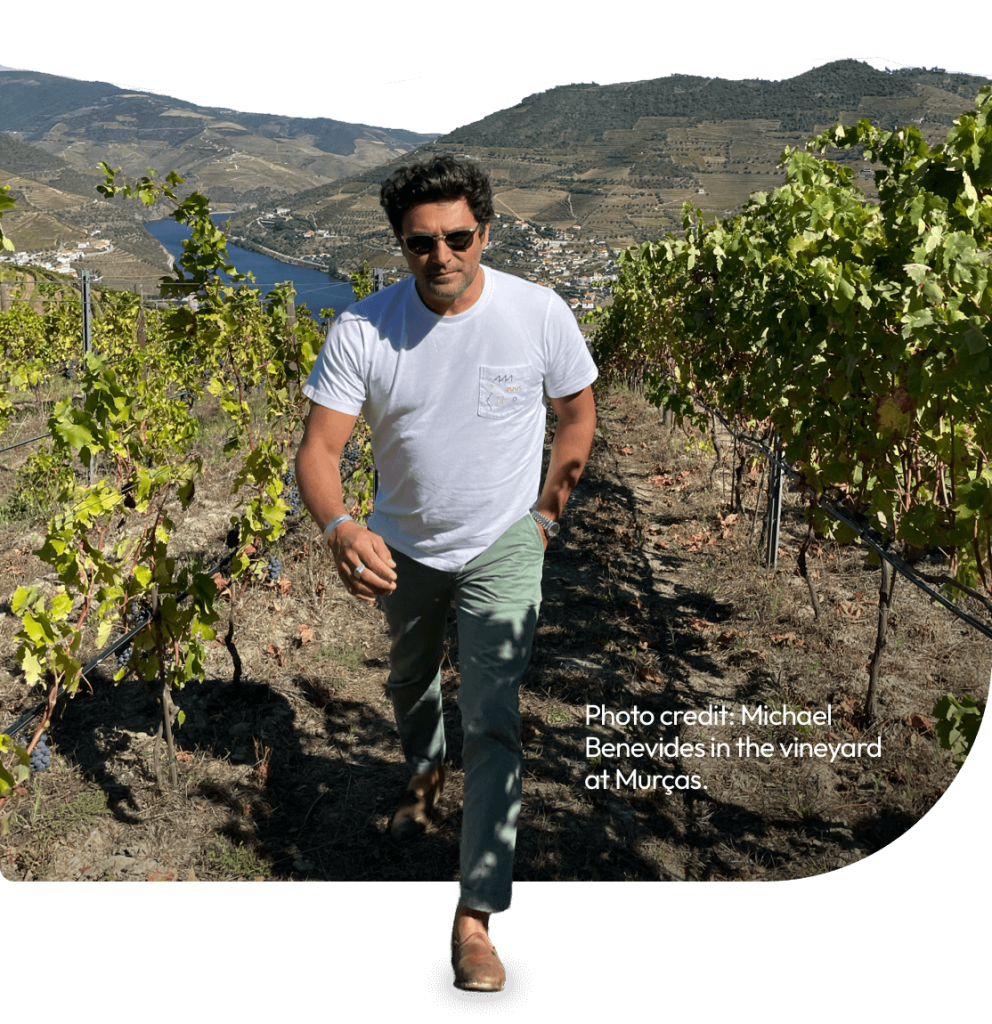
Outside Voices with Michael Benevides
Editor’s note: We spoke with our friend and longtime colleague, Michael Benevides of Portugalia Marketplace, about his experiences growing up in Fall River, Massachusetts. Read a preview below, and the full interview on our website. Follow Portugal on Instagram @portugalia_marketplace. The interview has been edited for length and clarity.
Portugal was not in fashion
Erin: Most Americans don’t grow up near a sizable Portuguese diaspora community. Until recently, most Americans likely didn’t have Portugal on their radar at all. What is your perception of this growing interest in Portugal?
Michael: It’s really interesting, growing up in a Luso-American community where everyone around you is Portuguese-speaking — and in some ways, experiencing a fair amount of discrimination for being Portuguese — because you were different from the other kids. There was some level of shame in the community, and the kids who interacted with American kids at school who got picked on would assimilate and lose their heritage a little bit. Growing up the way I grew up, Portugal was not in fashion.
My family is no different from many other families. My father came to the United States with $3,000 in his pocket; that was all he had. He rented an apartment, like every other person did in Fall River, and found a job in a boatyard within days of being here. He became a boat builder with no previous carpentry experience!
This speaks to [their] tenacity and perseverance … you do whatever you have to do to feed your family. My father was pretty driven, [and] my mother also worked in a factory. Both my parents were factory workers. And that was every other kid in my community’s story. We were children of immigrants. All our parents worked at Joann Fabrics, Quaker Fabrics, Duro Finishing; we all could rattle off the names of the factories that our parents worked in. That was the commonality that we had as kids.
I can’t believe that in a 20 to 30-year span, now people come to me and say, “I’m going to Portugal. Where do you suggest I go and what do you suggest I do?”
Why are we not representing this version of Portugal?
Michael: I had a pretty impactful trip when I went to Portugal—to the Azores—when I was 14. Those were my formative years … just trying to find out who I was as a person, and that trip really shaped me. I came back from that trip really jazzed about being Portuguese, and because of the experiences I had: the liberty and the freedom that I felt in the Azores was far greater than I felt in the US. My parents would allow me to roam, and go and explore, and I didn’t have those freedoms growing up in Fall River.
So, traveling to Portugal from a very young age, I became very inspired … I would just make all these mental notes, knowing that at some point when I came of age, I would become more involved [with the business] and that I would want to present this version of Portugal versus the version of Portugal that so many [in Fall River] knew.
I was able to bring a lot of contemporary new energy, which was a product of my environment, my upbringing, [and] the fact that I started going to Portugal on a pretty regular basis at age 18, attending trade shows and seeing how Portugal was beginning to evolve at that time. Seeing Lisbon, and being very inspired by Lisbon, and saying “Why are we not representing this version of Portugal?” I have very particular interests in design, and architecture … Culture is a really big thing for me. I run an arts festival (FABRIC), which is about promoting contemporary art, and often Portuguese contemporary art in the diaspora.
Big in the salt cod space
Erin: When you think back to the early days of Portugalia, are there any particular products that you remember being the thing that everybody was coming to get on a consistent basis?
Michael: Salt cod. Lots and lots of salt cod. Piles of them. Heaps and heaps. [Laughs]. We still have customers who remember me from that store and go, “I remember you behind the counter.”
We sourced arguably the best cod you could buy in the market, and we started to build a name and a reputation for being big in the salt cod space. That was definitely one of the products that was a standout, and boy could you smell it when you walked in! Hit you in the face.
Erin: On the food note, is there a favorite cod preparation from your family? Also, is there anything that’s surprising you that you’re seeing about the culinary scene happening in Portugal?
Michael: Cod’s always on every menu in Portugal, which is interesting to me. You can have it in the little taberna, and you can have it in a Michelin restaurant. When it comes to cod, I’m a bit of a purist: I like it simply grilled, like bacalhau assado na brasa, on the grill with simple potatoes. That dish to me is just quintessentially Portuguese: classic, very simple. Anyone can make it. I make it often. And then I do really like the casserole, layered version that we offer at Portugalia (bacalhau à Gomés de Sá).
There’s still a lot of classic food in Portugal, which I love. If given the opportunity to go to the classic spots, I always go to those, and then of course I always like to sprinkle in these places that are a little more progressive, doing interesting plays on tradition. The number of new restaurants that are constantly popping up in Portugal, I’m astonished by. Every time I go, I have to reach out to Rui [Abecassis] to say, ‘Hey, where do I need to be going?’”
The level of food, and the play on the classics … it’s interesting to see what didn’t exist even 10 or 15 years ago.
A billboard for the wines of Portugal
Erin: Is there a certain region or a style of wine that you think about when you think about the early days of Portugalia?
Michael: My first exposure to wine was Vinho Verde, and I think that’s what every Portuguese person first starts off with. My friends and I started drinking Vinho Verde in the Portuguese community. It was cheap, it was easy to drink, it had a little bit of residual sugar. We weren’t old enough to drink, but that was definitely a wine that I, along with a lot of people in my age group, had as their first exposure to Portuguese wine.
We got into the wine business 13 years ago with this market. Prior to that, we didn’t sell wine. As part of our concept, we set out to be a billboard for wines of Portugal. We said, “We’re going to carry everything that’s available.” So, when we opened up the market, many vendors reached out to us with their offerings. From smaller to larger suppliers, we work with a vast array of wine distributors to be able to offer the unique and large selection we have available.
Being from the Azores, it’s been really fascinating to see the wine scene grow there. If you told me 10 or 12 years ago that when we opened up the market, we’d be selling Azorean wines at this rate, I would have said, “I don’t think so.” [But] there’s a direct correlation between travel and interest, right? More and more people go to the Azores, and they become interested in those wines. It’s not [just] the Azorean community that consumes them.
When we started selling wine, people would come in and ask, “Do you have any Azorean wines?” There would be little to no offerings. Fast forward 10 years later we started to carry more Azorean wines as they became available to the market. We’d point them out, and the reaction from the Azorean community would be, “Are you guys crazy?” due to the expensive nature of the new breed of Azorean wines. But then those wines began to receive accolades, people started to take notice—especially people in the industry due to their unique profile. That’s definitely been one of the biggest surprises that I’ve witnessed in this market.
Erin: It’s interesting to see how these trends evolve and how styles and preferences change. We’re witnessing a renaissance for Alentejo!
Michael: [On Esporão] For many people, and even for the non-Portuguese community, Monte Velho put Portugal on the map. Then they introduced the Reserva, which I still think is, at that price point, one of the best buys from Portugal. That’s a really great wine and it’s gotten even better over time.
Esporão has always had a really good presence in the market, [and] I can’t speak highly enough. I’ve always been a fan. I’ve always heard that “Esporão leads and others follow,” even in terms of green initiatives and how [they] approach the business. Kudos to the Roquette family for being good stewards of the land. Esporão has always had a really solid reputation. In the Portuguese community, it is perceived as the premium.
The adventure and the journey
We came over in ‘79. In ‘ 83, my father bought his first home. It was just a lot of hustle, a lot of overtime. He and my mother worked countless hours. My grandmother came over with us … so I grew up with my grandmother in those years when my parents were just working their tails off.
[In the back of our multi-family house] there was a three-car garage … Portugalia started in that three-car garage as a small wholesaler of Portuguese imports. My father would go work on the business from 7 in the morning until about 3 in the afternoon, and then punch a clock at a factory from 3 to 11 for the first three years, because he didn’t know if he had a business. It was just, “Let me try this and see how this works.”
I have very fond memories of that time: being 11 years old, when my father started in ‘ ‘88. [He] would go off to work from 3 to 11, and there was a sign on the door of the garage that said, “If you need help, ring Doorbell.” People would ring, and my mother and I would go out—I didn’t want her going alone, even as an 11-year-old child. We’d go out there, customers would make some purchases, we’d bag them up, we’d ring them out, send them off, and go back inside the house.
And then it became too much; it became too many doorbell rings. At this point it became evident that we had a business starting to develop. So that’s how it all started. If I wanted to spend any time with my father, I had to tag along. It wasn’t spent on a baseball field, or on a soccer field, [but] I really enjoyed the adventure and the journey. It felt novel to me: when all of our neighbors, all of the parents, were factory workers, my father was charting his own path.
I was the first one to jump on the truck with my father when he had to go down to New Jersey to pick up product, because we didn’t have the capital to import product [directly] from Portugal. We would jump in a truck at 5 in the morning, drive down to Jersey, and then my father had to be back in time for the 3 PM punch-in at the factory. When I was 16 and a half, my father told me, “Go get your license right away.” I went to the DMV, [and] the day that I got my license, I was out in the truck. I can honestly say I’ve done everything: driven forklifts, unloaded trucks, loaded trucks, sales, deliveries, I did it all.
My father wanted me to be college educated. He was adamant about that because he never had that opportunity in the Azores. He knew the value of education, maybe because he worked at one point as a chauffeur at the University of the Azores, and he saw how educated people were treated. So, I went through four years of college, and I used [Portugalia] as a case study in my classes. I graduated, I had two weeks off, and then I went to work, and I’ve been here ever since. As a result, I have 37 years of institutional knowledge.
Learn more about Portugalia
In addition to a beautiful flagship store in Fall River, Massachusetts, Portugalia has a great web store and can ship all over the continental US. Keep up with them on social media (@portugalia_marketplace), and in their own excellent newsletter.